by Michael Smith (Veshengro)
“If we are going to sustainably improve the livelihoods of the developing world’s smallholder farmers in the context of a changing climate, we need to ensure that their priorities are understood and reflected in policies,” says IFAD’s Vice President Michel Mordasini.
The report, prepared by IFAD, suggests that practical technical interventions, such as enhanced seeds and accurate weather forecasts, are not enough and that ultimately national policies, a legal framework, strategies and budgets will shape the opportunities for large numbers of rural women and men to adapt to a changing environment.
The report points out that smallholder farmers know best the realities they face, and if they are not adequately involved in policy processes, they risk losing out and being sidelined in decisions that directly determine their ability to cope and adapt. The report highlights IFAD’s support for policy dialogue between governments and farmers, including special provisions to ensure that the adaptation priorities of women, young people and indigenous peoples are also heard.
The report presents five country case studies of how IFAD is strengthening the enabling environment for farmers trying to cope with climate change. One of the featured case studies is from Sudan.
“In Sudan, IFAD is supporting the development of 300 community adaptation plans that enhance resilience of women and men,” says Khalida Bouzar, Director of IFAD’s North Africa, Near East and Europe Division. “IFAD is building capacities of technical staff at local and state levels and strengthening their understanding of climate change adaptation and natural resource management, promoting arrangements that help reduce resource-based conflicts, as well as supporting policy through the development of a Sectorial Adaptation Strategy relevant to the livestock sector. This strategy will in turn be implemented through the community adaptation plans, as we believe that while climate change is a global problem, climate action is a local solution.''
IFAD is also working to support governments in embedding smallholder adaptation priorities in national policies. In Mozambique, for example, IFAD is working with the Centre for the Promotion of Agriculture to support the mainstreaming of gender and climate change adaptation into national policies on horticulture, cassava and red meat production.
“IFAD stresses the importance of reinforcing national institutions in dealing with climate impacts on smallholder farmers,” says Margarita Astralaga, Director of IFAD’s Environment and Climate Division. “In the Gambia we support policy makers learn from the experience of countries facing similar challenges.”
The report highlights the importance of global processes, such as the United Nations Framework Convention on Climate Change Conference (UNFCCC), as opportunities to keep smallholder adaptation priorities in the limelight.
The International Fund for Agricultural Development (IFAD) invests in rural people, empowering them to reduce poverty, increase food security, improve nutrition and strengthen resilience. Since 1978, we have provided nearly US$17 billion in grants and low-interest loans to projects that have reached about 453 million people. IFAD is an international financial institution and a specialized United Nations agency based in Rome – the UN's food and agriculture hub.
But what IFAD actually does is concentrating on small farmers in the Third World – no, I am not playing the pc game by calling those countries “developing countries” – but seem to have little if any time for smallholders in the so-called developed world. They have to fend for themselves without anyone carrying the flame for them.
All the smallholders and small farmers the world over must be given a place at the climate table, so to speak, for it is, in fact they, and not industrialized agriculture, that will mitigate climate change and feed the world.
We need more small farmers and smallholders rather than large farms to feed the world and to capture carbon and prevent agricultural pollution reaching air and water courses, especially when the farming is done on a more or less organic level.
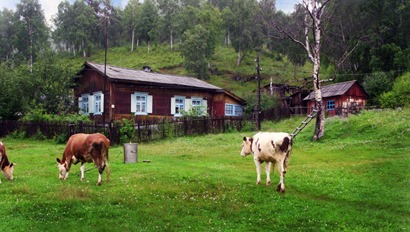
A look needs to be taken at how the small farms in Russia are working as to feeding the country and how more of such farms everywhere could really change food security. To get more such farms, however, would mean a serious land reform where those that truly are prepared to farm in a sustainable way to create food security for the nation (and the world) will be given land. This land can only come about, though, by expropriation of the large farms and also, such in the UK, the large, often unproductive, feudal estates, and the sooner this is being done the better.
© 2017