Showing posts with label disposable chopsticks. Show all posts

Uses for chopsticks in gardening

by Michael Smith (Veshengro)

How to use chopsticks in the garden and in gardening indoors and outdoors
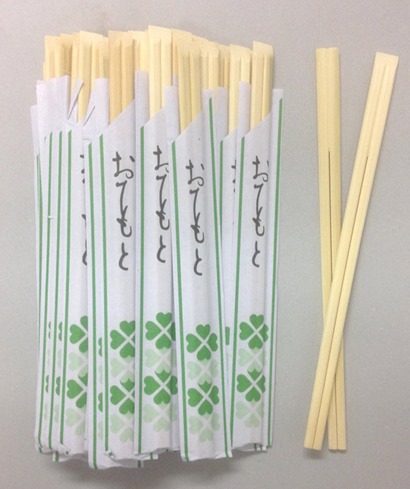
Uses for chopsticks in gardeningEvery year, billions of disposable chopsticks are manufactured in China and shipped across the globe to Asian restaurants and take-out restaurants and with almost every tray of sushi bought in supermarkets and other places you get a set of those as well.

Those chopsticks are made out of a variety of woods, including birch, spruce, cotton wood, or bamboo.

Before even considering using them in the garden and in gardening, though that is what, mostly, we will be looking at here, the first reuse of them is as what they are, namely chopsticks.

I have a couple of sets of those sets at home in the tin cans on the windowsill in the kitchen that hold the various items of cutlery. There is a tin for spoons, for knives, etc. and one of them has also got some (wooden) chopsticks in them (for use). I also carry a small set, in a leather wallet, for on-the go.

While I in no way support deforestation in the name of stuffing our faces with dumplings and Vietnamese Crab Fried Rice, I do appreciate, however, creative ways to reuse and recycle items that are otherwise discarded into the trashcan or at the very least stuffed into a kitchen junk drawer, as is all too often the case also with those chopsticks.

In Japan (and also China now, I believe) a trend was started a while back of “bring your own chopsticks” – much like the “bring your own cutlery” that has been advocated in the West, and this is certainly something that should be encouraged.

So, before reuse of such chopsticks in the garden think of reusing them as what they are and when you want to use chopsticks at home then use those. Or when going out where there is the chance that you may indulge in some Asian food then carry your own set.

Having said that I am well aware that often getting yet another set is unavoidable as in some cases they are prepacked with the meal you purchase and you have no choice and control over this.

Right, now for the reuse of chopsticks in the garden and gardening

Dibblet: A dibblet is one of those small dibbers for separating seedlings and replanting them. Some people use a small stick, a pencil or pen, or such while others spend money, actually, buying a special dibblet. Use a chopstick instead. Works great.

Seed Flags: After you have planted your seeds, it is time to make a label so you know where you have planted what. The best marker is a good old flag: Use colored tape, cut it into a fun flag shape, wrap it around one end of a chopstick, and use a marker to note the name.

Seedling Support Stakes: When seedlings coming up, and are getting tall they may need some support. Insert a chopstick into the dirt next to the plant, and loosely tie a piece of twine or string around it to help keep the plant upright as it grows.

Row Planting Guide: Want to make sure you plant your rows straight? Cut a piece of twine or string a few inches longer than your row will be, or just have a lot more string than you will actually need to have one you can use again and again. Tie each end to the tops of two chopsticks. Stick the chopsticks into the ground at either end of the proposed row so that the twine is suspended like a bridge. If you use more twine than you might need for shorter rows just wind then remaining stuff onto one of the chopsticks. You can use your trowel to dig into the ground directly below the twine, making a perfectly straight row.

Mini “Greenhouse”: Stick three chopsticks into a pot or individual seed starting cell, and fit a plastic bag over the top and you have an instant small propagator.

The above are, obviously, only a few ways in which you can reuse and make use of those chopsticks in the garden and gardening and I am sure many readers can come – and have come up – with other ideas in addition to those presented here.

© 2018

The bane of the wooden disposable chopstick

by Michael Smith (Veshengro)

disposable chopsticks1_webI might just be able to live with it – but then more than like not even then – if the majority of those disposable chopsticks that are given out with sushi and other East Asian takeout dishes were made of bamboo but they are not. The great majority are made of wood, and it would appear of some hardwood as well in most cases. Some of them may be bamboo but the majority that we encounter here seem to be more wood, hardwood, in nature.

Chopsticks have a long and storied history, dating back to 2100 BC when Da Yu, the founder of the Xia dynasty, was trying to reach a flood zone. In his haste, he didn't want to wait for his food to cool down, and adapted two twigs to help him eat his food quickly. With the popularization of Asian food all over the world, chopsticks – especially the disposable kind – are now being used the everywhere.

But “throwaway” chopsticks are an unmitigated environmental disaster. In China alone, 80 billion chopsticks are thrown away each year, requiring hundreds of acres of forest to be cut down every day just to keep up with the demand, so some reports go. From where we are sitting this is, obviously, very hard to verify. In response to this, however, the Bring Your Own Chopsticks (BYOC) movement began and is gaining ground in places like Japan, China and Taiwan.

Often I tend to find them thrown away unused, still in their packets, which means that the person eating the dish opted, more than likely, for a plastic fork or spook instead of the supplied chopsticks. In that case the chopsticks come home with me to be (re)used as tools for which they are intended for, namely eating with.

From those I have made up a couple of BYOC sets, one in a leather sleeve that can be easily tucked into a pocket, for use when out and about so as not to use disposables from a restaurant.

Those that are out of their packets and have been used or otherwise tossed are reworked into dibblets, that is to say for tools to prick out seedlings in gardening.

In North America, apparently, those single use chopsticks are more of bamboo than of hardwood. How that is to be I do not understand but so the story goes and in Canada recently a young start-up has begun recycling those into a variety of products.

In Vancouver, Canada, this young start-up called “Chopvalue” cleans them up and turns them into home accessories and furniture.

Chopvalue's founder, Felix Böck, is a doctoral student in the faculty of forestry at the University of British Columbia. The idea for the start-up came when he realized how many chopsticks were thrown out every day.

Böck estimates that in Vancouver alone over 100,000 pairs of these utensils are sent to the landfill every day. Wanting to do something to address the problem, Böck invested in some recycling bins, and recruited restaurants to get their customers to throw their bamboo chopsticks in the recycling bin, rather than in the trash. These are then picked up by Chopvalue, and then taken to their lab, where they are cleaned, coated in resin and then hot-pressed with a machine to come up with a flat material.

The use of a fair amount of resin in the making of the products, however, makes me question the green credentials of this though as no information is given as to what kind of resin is being used. Also the heat and pressure in the production required a great deal of energy and again the green credentials are, thus, at least in my opinion, more than questionable.

Better would be if we would first of all not use them and really bring our own chopsticks or, alternatively, find ways to reuse and upcycle those sticks on a different level that does not require an amount of chemicals and energy. I am sure that it can be done in a way that is much better for the environment than making “planks” our of them by use of resins, heat and pressure.

© 2017

China's 80 billion-a-year chopstick habit has serious impact on forests

by Michael Smith (Veshengro)

China's ever increasing demand for disposable chopsticks is taking an serious and ever growing toll on the country's forests, Chinese state media reports.

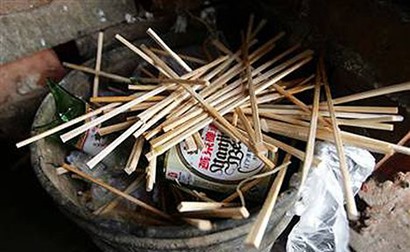
waste wooden chopsticksAccording to Bai Guangxin, chairman of Jilin Forestry Industry Group, China produces 80 billion disposable chopsticks per year, up sharply from the 57 billion estimated by the state forestry administration in 2010. Bai told Xinhua that 20 million trees are felled annually to meet demand. He didn't specify the origin of the trees, but domestic sources would mostly come from forest plantations since the country banned natural forest logging after devastating floods in 1998.

Bai said that chopstick demand risks undermining the country's reforestation and afforestation targets. Accordingly, he recommended that people carry their own chopsticks when they dine out at restaurants.

Previous efforts to stem the use of disposable chopsticks – including a use tax in 2006 and a threat of increased government regulation in 2010 – have apparently failed.

If it is true that the the timber for those chopsticks comes from domestic sources and in that case from plantations which have been created and are managed for this purpose then this is one thing and a lot more sustainable. However, if foreign sources and natural forest logging is part of this then things look different altogether.

While everyone immediately panics when the talk is of trees being cut for the production of this or that the source of the tree is what matters. It is the same with chopstick production as with paper.

That is to say that is the sources are from sustainably managed plantations, as is the case for most of the paper industry, for instance, the fact is that were it not for this particular industry those forests would not even exist.

On the other hand, if the wood is sourced in other ways then we do have a serious problem, especially if not replanting is undertaken, as is the case, so it is understood with Kimberly-Clark’s operations in the boreal forests of Canada.

We have now had the advice given to Chinese – and the same advice is being given to Japanese – diners to bring their own chopsticks when they go out to eat and still, it would appear, the demand for the disposable ones is increasing year by year. The message, thus, does not seem to have gotten through. Reinforcement may be required by way of legislation and a tax on disposable chopsticks.

And such a tax would also be good in the West for the same, as tons of disposable chopsticks are also used by those buying take-out Sushi, for instance, and Chinese meals. Also such a levy would also come in handy, maybe, to curb the use of disposable cups and cutlery in general.

The bring-your-own (BYO) principle is not difficult but it would appear that people are simply too lazy to do it all too often and the same also applies as regards to shopping bags.

When I grew up it was traditional for us to carry our own set of cutlery and then, as a military man that was again the way. So, still today, I carry, and the same for several other things, such as refillable water bottle. It can be done but needs forethought.

© 2013