Showing posts with label bicycling. Show all posts

200 years on the bicycle is more needed than ever

by Michael Smith (Veshengro)
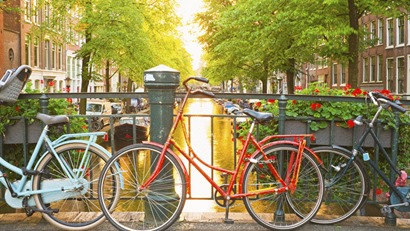
bicycles_Amsterdam1Does it have to be a brand-spanking-new bicycle? No... The old one that you may still have standing around in your shed given a little TLC or some other secondhand one would be much better and ideally without the fancy gearing of today.

On June 12, 1817 the bicycle saw the light of the world, in the form of the Laufmaschine (Draisine), by making its maiden voyage under the captainship of its inventor, Karl Drais. It has come a long way since and today is more needed than ever.

It was born out of the need for a replacement – albeit temporary – of the horse as very few horses were left in Germany at that time due to a climate event which brought about “the year without a summer”.

Today not just a climate event but climate change makes the bicycle even more important, and in this case as a replacement for the modern horse, the motorcar.

While the climate event of 1817, “the year without summer”, went away, the climate and weather returned to normal. Horses came back into use as they could be fed again and there was food for people again too. The bicycle, therefore, descended into obscurity for some time. With climate change this is, more than likely, not going ever be a return to normal and we will have to look to the bicycle as a low-carbon alternative for travel.

Today's bicycles are about as far removed from the original concept of the running machine, the Draisine, as is the ox cart from the modern car, with the exception of the balancing bikes for children nowadays which are almost a Draisine, having no pedals.

Bicycles do not, that is true, do not achieve the speed of a car and neither can they travel the same distance in a day as can a motor vehicle. On the other hand though most cars are not used daily for long distances but mostly for short trips (with the exception of those that may use them indeed for long commutes) for which a bicycle would not only be more efficient and cheaper but also faster.

By the time you have the car ready to go on the road, especially if it is kept in a garage, have buckled up and all that, you would already be half way there with a bicycle. Then at your destination, say the high street, you have to find a place to park the car, and more than likely that will take some time and may even cost you money to boot. The bike, on the other hand, you can just “chain” to the nearest lamppost or such and you can do what you want and need to do.

The bicycle is also one of the most energy efficient vehicles for public transportation. Instead of burning fuel and money and making you fat it burns fat and keeps you fit. Though as a cyclist I do realize that in many countries the infrastructure is not there for cycling, at least for safe cycling, and drivers of motor vehicles, from cars to trucks, see the cyclists as someone, more often than not, who should not be on the road with them. That needs to change.

While we are seeing a year by year increase in bicycle use in Britain, including for commuting, no real serious change will come about until the political will is there to change the status of cycling infrastructure by creating safe paths for cyclists (and pedestrians) alongside every, or at least almost every, road, that are separate from the road itself. What can be done in other European countries can be done in the UK and no one can tell me different.

© 2017

Old-fashioned ways for the modern age

by Michael Smith (Veshengro)

When speaking here of and referring to old-fashioned ways I do not – necessarily – mean in a Luddite way or in a way similar to the Amish who refuse – basically – to have anything to do with modern ways.

old-fashioned-waysIt is not those – per se – that I will be speaking of but of the ways of old that especially today would be good for us and the Planet if they be brought back.

The old-fashioned ways I shall be considering and speaking of here are those that society today more often than not thinks quaint and antiquated, like walking and cycling instead of using the car, using pen and paper instead of electronic means for writing, for instance. As well as speaking with people face-to-face or on the telephone instead of sending text messages. And also making do and mending and making things rather than buying them.

The motorcar, it has to be said is beginning to fall out of favor in the second decade of the twenty-first century and that especially with young people and that to such an extent that many are not even bothering, while making the driving license, to actually acquire a car themselves. Instead they take to cycling, including for the daily commute.

This is a good turn of events as it cuts down on pollution from motor vehicle traffic – the less of them on the roads the better – and is good not only for the Planet and the doers' wallets. It also keeps the doers fit and healthy, if they do not get knocked off their bikes by inconsiderate motorists who seem to believe that they own the roads. But safety can be found in numbers here (as in so many cases) and the more people who will take to the bicycle the better.

The cost of fuel and everything else associated with owning and sunning a car is one of the reasons that the old-fashioned way is becoming rather popular again, that is to say the walking and the cycling.

A bicycle is not just cheaper to buy and cheaper to run. It also can be (almost) entirely maintained at top condition by the owner and also repaired. The bicycle is, however, but one of those old-fashioned ways that is making rather a comeback. The humble typewriter is another.

TYPEWRITER

In late Spring 2013 the Russian secret service community announced that, in light of the electronic spying by the NSA and GCHQ disclosed by Edward Snowden, the services are returning to using typewriter, albeit electric ones, for sensitive documents and communications. Thus the announcement of the death of the typewriter has been very premature indeed.

The typewriter is far from being an old hat and dead even though it could have been thought so with the large use of computers and such nowadays.

To all intents and purposes, however, the typewriter is very much alive and is having rather a renaissance these days and that includes also and especially manual ones.

Manual typewriters, and here especially old working ones, are sought after once again and not (just) to put on display. They are intended and bought for use. Reports even suggest that young people especially, in places such as the USA and other hyper-modern countries, are looking at using and learning how to use typewriters again.

PEN & PAPER

Pen and paper is another old-fashioned way whose death has been announced very prematurely indeed. In fact pen and paper is having rather a revival if the amount of Moleskine and other notebooks that can be seen carried and used and here very much again by the younger generation, especially young professionals, is anything to go by.

head-medium_0For many years we have been told – brainwashed in fact – that computers would make pen and paper obsolete and also that we should reduce and even eliminate the use of paper and go “paperless” in order to save the (rain) forests.

The latter, as to the rainforests and paper, is a total fallacy at best and an outright lie at worst as paper pulp cannot be produced from (tropical) hardwoods.

Why we are thus being lied to in such a way I cannot say but what I can say if that pen and paper are still very much in use and, it would appear, are coming back in vogue.

Even the use of the fountain pen is coming back and many of those that have taken to using Moleskine, Leuchtturm1917 and similar quality notebooks also invest in good quality fountain pens to use with those notebooks. Here it is also mostly “real” fountain pens – filled from an ink bottle – rather than cartridge pens.

Slowly, it would seem, many people are coming back to the realization that not everything modern is what it is made out to be and that not everything that glitters is gold. There is a great amount of fools' gold around which has been mistaken for the real stuff.

Too many of the good old-fashioned ways are not, as yet, coming back into their own but in order to bring back sanity into all of our lives and for the sake of the Planet they must be revived.

MAKING DO & MENDING is one of those and while the mending with products today that are made to break down easily and designed so they cannot be repaired in most cases it is a bit hard – but we can change that too – the making do is what we all can do already now. Especially here as to making do with what we already have as long as it works (well) and does the job.

Making do is something that we can and must do (again) for the sake of sanity, our wallets, and especially for the Planet. We only have this one Planet, we only have one Mother Earth.

Our ancestors, and especially here those of the working class and the peasantry, were masters in the making do department and from their ways, some of which are recorded in books and other publications, we can surely learn a great deal and we also must.

© 2013

Cycling Britain's fastest growing mode of transport

by Michael Smith (Veshengro)

Cycling is one of the fastest growing modes of transport in Britain. It is clean, healthy and good for the environment. But the government is still lagging behind those of other EU countries in providing a proper safe cycling infrastructure for British cyclists.

The Mayor of London, Boris Johnson, has created a “vision for cycling”, but then he is a cyclist and understands, for an unbroken network of cycle routes in London. And while there are many things that one could disagree with with Mr. Johnson this is not one of them.

However, we need more than just an unbroken network of lanes, as they are today, even though very fragmented, as they are not safe for cyclists. The lanes must be, as they are in most countries of Europe, physically separated from the motor traffic.

Mayor Johnson has also stated that he wants to “de-Lycrafy” cycling and bring it to the masses and this is indeed something that must be done if we want to have a sustainable low- to zero-carbon transportation future.

This vision in which many of us who use bicycles to get around, some as primary mode of transport even, share with the Mayor of London can only come true if we keep knocking at the right doors by demanding that proper, separated, bicycle lanes get created in the same way of those that can be found on the European mainland, whether in the Netherlands, in Germany or in Denmark.

Cycling is becoming, and it is evident in the new faces one can see on a daily basis using the bike for commuting, to go to the shops or to visit friends, more popular than it has been for many decades and many young people shun the car, in fact, in favor of the bike.

One of the main fact, aside from environmental consciousness and wishing to become fit or fitter, for cycling being the fastest growing mode of transportation in Britain today is the ever increasing cost of fuel and motoring per se, for insurance and road tax also pay part in this.

Motorists are always fuming about the fact that cyclists need not to pay the road fund license and neither have to have insurance but no one forces those people that moan to use their cars. They too could use a bike. In addition to that they seem to forget that the bicycle was here before the car, as were pedestrians.

Britain has been, and still is, sadly lacking behind other countries in Europe as to provisions for cyclists and if one sees the cycle lanes in places such as the Netherlands – yes, OK, more people use bikes than cars there – and in Germany, which go from about everywhere to everywhere one can but dream and hope to get something like that in the UK too (one day).

Unfortunately, presently, Britain has the worst provisions for cycling and cyclist of all the EU countries and this is, despite the increase in cycling as mode of transportation presently, still preventing many people from getting on their bike instead of into their car, especially for shorter journeys. This must change for our health and for that, especially, of the Planet.

© 2013

WHAT’S NOT TO LIKE ABOUT THE BIKE? CIWEM URGES GOVERNMENT TO BACK BORIS’S VISION FOR CYCLING

Cycling is one of the fastest growing modes of transport in Britain. It is clean, healthy and good for the environment. CIWEM has joined cycling groups in calling on the government to back the London Mayor’s vision for cycling, invest in his proposals for an unbroken network of cycle routes in London, and roll it out across Britain.

The Chartered Institution of Water and Environmental Management (CIWEM) is pleased to support the London Mayor’s proposals to “de-Lycrafy” cycling and bring it to the masses. A new London cycling super-highway to encourage commuters on to bikes will bring huge benefits. It will improve London’s environment, improve people’s health and wellbeing and bring new investment and jobs.

The forthcoming publication of a report by the All Party Parliamentary Cycling Group is likely to bring pressure on the government to support the London Mayor’s plans, and to find the nearly one billion pounds needed to fund the scheme. CIWEM urges the government to follow the Mayor’s lead and roll out similar proposals to other cities and towns across Britain. The health, environmental and economic benefits would be significant, and lead to a transformation of our transport systems. CIWEM believes this one infrastructure plan that makes sense and is genuinely sustainable.

CIWEM Executive Director, Nick Reeves OBE, said: “It’s time to change our transport habits and learn to love our bikes. Boris Johnson’s vision for an unbroken network of cycling superhighways across London is the perfect infrastructure project that is also genuinely green. It will democratise cycling, improve our health and our environment, create jobs and launch a transport renaissance that could be introduced to all our cities and towns. In a time of austerity, this is just the sort of investment the country needs to get Britain working, clean up our urban centres, and get us fit.”

CIWEM’s vision for sustainable, local transport and infrastructure will soon be outlined in forthcoming policy position statements.

The Chartered Institution of Water and Environmental Management (CIWEM) is an independent professional body and a registered charity, advancing the science and practice of water and environmental management for a clean, green and sustainable world. www.ciwem.org

The All Party Parliamentary Cycling Group is a cross-party group of MPs, is co-chaired by Ian Austin, the MP for Dudley (Lab) and Julian Huppert, the MP for Cambridge (LD). It has conducted an Inquiry and taken evidence on cycling and will publish its report with recommendations in April 2013. http://allpartycycling.org/

Full Disclosure Statement: The GREEN (LIVING) REVIEW received no compensation for any component of this article.

This article is for your information only and the GREEN (LIVING) REVIEW does not (necessarily) approve, endorse or recommend the product, service or company mentioned.

Increase in rail and bicycle usage in Britain

By Michael Smith (Veshengro)

According to recent figures rail journeys in the UK have increased tremendously pointing to the fact that people leave the car at home more because of the cost of fuel going up, and up, and up.

Bicycle usage also has risen rather greatly from what I can observe on a daily basis and more and more people seem to join the throng of those riding through our parks on their way to work or from work, or to take the children to school, or to go to the stores.

With the equivalent of US$8 and more for a US gallon of ordinary gasoline this change in choice of mode of transport really is not surprising. What is surprising that not more bikes are about on the commuting trail and the school run or the trip to the stores for the pint of milk or the loaf of bread.

The way people are and have been using the car is not really sustainable and nor has it ever been. We clog up the village and town centers, the roads to and fro, and we pollute the air. Short journeys cause much greater emissions than the loner runs and vehicles idling are the biggest cause of automobile air pollution.

While most readers of this journal will know the facts as to pollution caused by idling cars and such like very well indeed already it is, nevertheless, interesting and, dare I say, encouraging, to see that rail journeys are going up and, as far as I can see, the use of bicycles too is very much on the increase, for commuting as well as for taking the kids to school or for the run to the shops.

Let us just hope – and, those who do, pray – that this increase will not just dissipate again if and when oil and gasoline become cheap again. Not that I, personally, think that this is going to be the case again, ever.

And if it is indeed the case that the era of cheap and abundant oil has come to an end everyone best prepare for a return to mass transport, such as, especially, rail, for the longer journeys and to the use of the bicycle and walking for the shorter journey. Unless, that is, you can afford to keep and maintain (no, not a musket, silly) a horse and cart.

The problem though is that this fact is not, as yet, really sinking in with the majority of the people who still think that they are entitled to a car and to be able to be running it.

I don't know about such entitlements. Even the Constitution of the United States of America does not make mention of any of that. There is no right to have access to cheap gasoline enshrined in that document, not even in any of the many Amendments to said Constitution.

© 2011

Britain invests big money in bicycles

by Michael Smith

While certain American politicians complain about a million dollars being included in the country's energy plan to promote bikes, in Britain is investing £140 million (about US$ 280 million) to create dedicated bike lanes, provide bike parking, safety training, on-street bike rental networks and a campaign to promote bicycling in 12 Cycling Demonstration Towns.

£100 million of the money, granted to the 12 Demonstration Towns, will be used to create dedicated bike lanes, provide bike parking, safety training, on-street bike rental networks and a campaign to promote bicycling. The towns include Blackpool, Cambridge, Chester, Colchester, Leighton/Linslade, Shrewsbury, Southend on Sea, Southport with Ainsdale, Stoke, Woking and York. The project will be coordinated by Cycling England, a national agency that was formed in 2005. The additional £40 million is allocated to safety and training, particularly for children, as well as infrastructure to encourage cycling to school.

The Transport Minister, Ruth Kelly says "A quarter of journeys made every day by car are less than two miles. Cycling is an alternative that could bring real health benefits to millions of adults and children, as well as helping them save money and beat congestion."

"The first step in persuading people to leave their cars at home is to offer them a real choice," said the minister. "Providing a step change in cycling facilities, dedicated cycle lanes, more training and information will have a big impact on how people choose to travel."

We at the Green (Living) Review have been calling for dedicated proper cycle lanes, modeled on those in Germany and the Netherlands and, maybe, we are now finally getting those, if the minister is to be believed. This is, certainly, not before time.

As I have already said in my previous article about the bicycle and the law maybe a change in the law is required that will make it legal for cyclists, as long as it is done with caution and pedestrians given priority, to use sidewalks where no dedicated safe cycle lanes are available.

The UK need not look far to see the opportunities for cycling that can come from this investment. Britain's neighbor, the Netherlands, are known as a cycling paradise, and further north Denmark too is more or less the same. Germany also is a leading light as far as cycling is concerned and, to some degree, has always been. England has a good case for believing that they can meet their goal of getting 2.5 million Brits to take up cycling, including that a quarter of all car trips in the UK are less than 2 miles.

While Britain still has a way to go to get the infrastructure right and especially the laws in place, together with education, and not only of cyclists but especially of motorists, this can but be seen as a good start.

We also, as said, do not have to look far afield to see models of how things can work. On the near continent we have good examples from which the British government can but learn. Let us just hope it does not take another 10 years or so of expensive studies and pilot projects before we are even starting to get the infrastructure in place.

© M Smith (Veshengro), November 2008
<>