Showing posts with label United Nations. Show all posts

World leaders given 'trash' to eat at United Nations to highlight food wastage

A menu for a United Nations lunch lists items made from 'trash'

World leaders accustomed to fine dining had a surprise on their plates on Sunday at the United Nations — trash.

Chefs cooked up a lunch made entirely of food that would have ended up in garbage bins, hoping to highlight the extraordinary waste in modern diets and its role in worsening climate change.

On the menu for the lunch at the UN headquarters was a vegetable burger made of pulp left over from juicing, which typically wastes most of the produce.

The burger came with fries created from starchy corn that would typically go to animal feed — which along with biofuels is the end product of the overwhelming majority of the 36 million hectares of corn grown in the United States.

"It's the prototypical American meal but turned on its head. Instead of the beef, we're going to eat the corn that feeds the beef," said Dan Barber, a prominent New York chef who co-owns the Blue Hill restaurant.

"The challenge is to create something truly delicious out of what we would otherwise throw away."

Mr Barber crafted the menu with Sam Kass, the former White House chef who drove the anti-obesity "Let's Move" campaign of first lady Michelle Obama.

Read more here.

Protect nature for world economic security, warns UN biodiversity chief

Ahmed Djoghlaf says nations risk economic collapse and loss of culture if it does not protect the natural world

A-villager-walks-through--001

Britain and other countries face a collapse of their economies and loss of culture if they do not protect the environment better, the world's leading champion of nature has warned.

"What we are seeing today is a total disaster," said Ahmed Djoghlaf, the secretary-general of the UN Convention on Biological Diversity. "No country has met its targets to protect nature. We are losing biodiversity at an unprecedented rate. If current levels [of destruction] go on we will reach a tipping point very soon. The future of the planet now depends on governments taking action in the next few years."

Industrialisation, population growth, the spread of cities and farms and climate change are all now threatening the fundamentals of life itself, said Djoghlaf, in London before a key UN meeting where governments are expected to sign up to a more ambitious agreement to protect nature.

"Many plans were developed in the 1990s to protect biodiversity but they are still sitting on the shelves of ministries. Countries were legally obliged to act, but only 140 have even submitted plans and only 16 have revised their plans since 1993. Governments must now put their houses in order," he said.

Read more here.

US Spying a Threat to Global Climate Deal

by Michael Smith (Veshengro)

climate-change-conference1The US government has been at it again spying at all and sundries and this time it is revealed the target were the UN Climate Talks and its participants.

Activists and experts have expressed outrage at the revelations that the US government, through the NSA and its allies, has conducted espionage on participants of UN climate talks.

They are calling for President Obama to commit to no further spying on participants of the talks, accompanied by a drastically increased commitment to climate action on the part of the United States, if the talks are to succeed as they build toward another global summit at the end of 2015.

"The UN climate talks are supposed to be about building trust - that's been under threat for years because of the United States' backward position on climate action - these revelations will only crack that trust further," Meena Raman, negotiations expert from the Malaysian based Third World Network, said.

Brandon Wu, Senior Policy Analyst with development organization ActionAid in the United States, said: "Fighting climate change is a global struggle, and these revelations clearly show that the US government is more interested in crassly protecting a few vested interests - rather than acting ethically by taking responsibility to lead and working cooperatively with others to find solutions."

"This is yet again an underhanded, undemocratic and arrogant use of power by the US government to protect corporate interests. We urge the citizens of the United States to condemn these actions by their government and call for an immediate stop to its blocking progress in the climate talks," said Lidy Nacpil, director of Jubilee South Asia Pacific Movement on Debt and Development, a social movement headquartered in the Philippines.

And Asad Rehman, Head of International Climate at Friends of the Earth EWNI in the UK, said: "If Obama's rhetoric on climate change in the State of the Union is to be believed he must use an executive order to stop spying on climate negotiators and take up a position on pollution cuts that is consistent with the science."

But, let's face it, the United States government and its funders, the industries with vested interest, and those of it allies, have no interest in the success of the UN Climate Talks as that could and would mean that things would have to change. This could not possibly allowed to happen now, could it, as it would cut into the profits of the companies and the “income” of the politicians industry has managed to bribe.

All the United States and most other developed countries do is pay lip service with regards to climate change and the wish to make changes and then they look at (1) buying carbon credits from Third World countries and (2) play with fire by claiming that nuclear power is the answer to a carbon-free future. But I will not start a discourse on nuclear even though it is not the answer. The fact is that the powers that be in the developed countries have no interest in reduction of carbon emissions and reduction of consumption as that does not bring them money; it is as simple as that. And that is why the likes of the US and the UK will spy on the talks in the same way that they declare climate protests acts of terrorism.

There is lots of rhetoric from the sides of the powers that be in the often referred to as “Western” nations but it is but rhetoric as far as climate action is concerned totally missing the point that action is required and total different action that which they are advocating in their speeches and all the papers that are being produced by them.

They wish to have business as usual and further economic growth (and this is not just the way it is seen in the developed world) on a Planet that cannot grow and with ever diminishing resources. How that is supposed to work beats the hell out of me, for sure.

A copy of the leaked document, which concerns the 2009 climate talks in Copenhagen, can be found here.

© 2014

World Habitat Day 2013

by Michael Smith (Veshengro)

October 7, 2013 marks this year's World Habitat Day and the theme for this year is “Urban Mobility”. With this World Habitat Day 2013 acknowledges that mobility and access to goods and services is essential to the efficient functioning of our expanding cities and towns. Accessible cities encourage a shift towards more sustainable modes of transportation and draw more and more travelers out of cars and onto trains, buses, cycle paths, and footpaths.

sustainable-transport_ssFar too many towns and cities, especially in Britain, are no laid out well for alternatives for the motorcar at all and London, the capital, is no exception. So-called bicycle lanes and paths all too often are not separated from the main traffic and are actually more a hazard to cyclists than a help. Despite this, however, the Mayor prides himself of the x-miles of cycle routes. And things are even worse in other cities and towns and we do not even want to talk about the situation in most places in the United States.

If we are really serious about urban mobility and the possibility of people living in towns and cities to get about without the use of the motorcar then changes must be made to the infrastructure and cycle routes and foot paths be created that can get you anywhere without problems.

For this we must look to the European mainland, to countries such as the Netherlands, Denmark and Germany first and foremost, and especially the cities of Copenhagen (Denmark) and Amsterdam (Netherlands) from where to take the lead.

It is also necessary to breathe new life into the high street and make it possible for people to shop not at out-of-town supermarkets and malls but at shops just around the corner for about the same costs as in those huge places that are more often than not located well outside the towns and cities and require the car to get to.

This is as much part of urban mobility as the creation of the right mobility infrastructure with foot paths and cycle lanes, both needing to be physically separated from the motor traffic, and also a proper public transport infrastructure.

The lack of all of that – and laziness also – makes for people using the car for even the shortest of journeys even, such as going a few hundred yards, literally, up the road to the railway station, as can be seen daily in the area where I live. People will jump into the car to go the distance that would require but five minutes or such to walk then park for the entire day blocking parking spaces in the high street in order to travel into London by train.

The case just described above is down to laziness, without doubt, in this area there are sidewalks they could walk rather safely and much more conveniently than using the car and then having to park. Considering the time it takes to get into the car, get it out of the dive, get up the road and then park it, they could walk the distance almost twice.

Thus, it not just requires the necessary infrastructure but also a change in mindset of the people in general to get away from jumping into the car for such short journeys.

If we look at cities such as Copenhagen or Amsterdam and outside their railway stations we will find very few cars parked there but hundreds to thousands of bicycles. And if we but watch the arrival of the people commuting by train their either cycle to the station, if they come from a little distance away, or come on foot, unlike in Britain or the United States.

It is true that distances in the United States are greater from home to stores or station but in towns and cities the bicycle or Shank's pony would be faster even in there. It is different in rural locales but that is not what we are looking at here.

Urban living is on the rise and it is estimated that up to 60% of the world’s population will live in urban areas by 2030. We thus must work harder still to create towns and cities where walking and cycling are primary transport options as such mobility is good for the environment, the economy and our well-being, providing a range of social and health benefits for individuals. Cycling and walking keeps people healthy and the fact that a bike can be parked almost anywhere, as long as there is somewhere to lock it to (bike racks are nice), and walking needs not even that consideration the high street can and will be revitalized as well and the local economy will benefit, as will air quality and thus all of us.

© 2013

Wake up before it is too late

Take ‘mosaic’ approach to agriculture, boost support for small farmers, UNCTAD Report urges

Trade and Environment Report says small-scale farming needs

by Michael Smith (Veshengro)
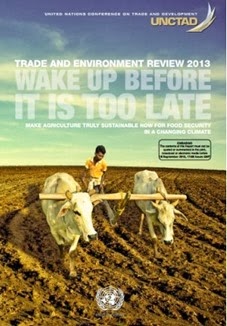
unctadGeneva, Switzerland, September 2013 : Farming in rich and poor nations alike should shift from monoculture towards greater varieties of crops, reduced use of fertilizers and other inputs, greater support for small-scale farmers, and more locally focused production and consumption of food, a new UNCTAD report recommends.

The Trade and Environment Report 2013 “Wake up before it is too late” warns that continuing rural poverty, persistent hunger around the world, growing populations, and mounting environmental concerns must be treated as a collective crisis. It says that urgent and far-reaching action is needed before climate change begins to cause major disruptions to agriculture, especially in developing countries.

The report, subtitled Wake up before it is too late: Make agriculture truly sustainable now for food security in a changing climate, was released today. More than 60 international experts contributed to the report’s analysis of the topic. The study notes that the sheer scale at which production methods would have to be modified under these proposals would pose considerable challenges. In addition, it would be necessary to correct existing imbalances between where food is produced and where it is needed, to reduce the power asymmetries that exist in agricultural input and food-processing markets, and to adjust current trade rules for agriculture.

The Trade and Environment Report 2013 recommends a rapid and significant shift away from “conventional, monoculture-based… industrial production” of food that depends heavily on external inputs such as fertilizer, agro-chemicals, and concentrate feed. Instead, it says that the goal should be “mosaics of sustainable regenerative production systems that also considerably improve the productivity of small-scale farmers and foster rural development”. The report stresses that governments must find ways to factor in and reward farmers for currently unpaid public goods they provide – such as clean water, soil and landscape preservation, protection of biodiversity, and recreation.

Climate change will drastically impact on agriculture, the report forecasts, primarily in the developing regions with the highest future population growth, such as sub-Saharan Africa and South Asia. Much slower agricultural productivity growth in the future and fast-rising populations in the most vulnerable regions will almost certainly worsen current problems with hunger, drought, rising food prices, and access to land. These pressures may easily lead to massive migrations, and to international tensions and conflicts over food and resources such as soil and water.

The report cites a number of trends that collectively suggest a mounting crisis:
• Food prices from 2011 to mid-2013 were almost 80 per cent higher than for the period 2003–2008;
• Global fertilizer use has increased by eight times over the past 40 years, although global cereal production has only doubled during that period;
• Growth rates in agricultural productivity have recently declined from 2 per cent per year to below 1 cent;
• Two types of irreparable environmental damage have already been caused by agriculture: nitrogen contamination of soil and water, and loss of biodiversity;
• Greenhouse gas emissions from agriculture are the single biggest source of global warming in the South. They also the fastest growing (along with emissions from transport);
• Foreign land acquisition in developing countries (often termed “land grabbing”) in recent years has amounted, in value, to between five and ten times the level of official development assistance.

But most important of all are the persistent problems with hunger, malnutrition, and access to food. Almost 1 billion people currently suffer from hunger, and another 1 billion are malnourished, the report notes, even though current global agricultural production already provides sufficient calories to feed a population of 12 to 14 billion. Some 70 per cent of the hungry or malnourished are themselves small-scale farmers or agricultural laborers, indicating that poverty and access to food are the most critical challenges.

Monoculture and industrial farming methods are not providing sufficient affordable food where it is needed, the report says, while the environmental damage caused by this approach is mounting and is unsustainable. It says that the highest priority must be given to enabling the rural poor to become self-sufficient in food or to earn sufficient income through agriculture so that they can buy food.

The report emphasizes that a shift is necessary towards diverse production patterns that reflect the “multi-functionality” of agriculture and enhance closed nutrient cycles. Moreover, as the environmental costs of industrial agriculture are largely not accounted for, governments should act to ensure that more food is grown where it is needed. It recommends adjusting trade rules to encourage “as much regionalized/localized food production as possible; as much traded food as necessary.”

The past strategy of relying on international markets to meet staple food demand, while specializing in the production and export of “lucrative” cash crops, has recently failed to deliver its desired results, because it has relied on low staple food prices and no shortage of supply in international markets, conditions that have drastically changed since the turn of the century, the report notes. Also, globalization has encouraged high levels of specialization. This has resulted in an increasing scale of production of a smaller variety of crops, and has created enormous cost pressures, the report states. All this has aggravated the environmental crisis of agriculture and has reduced agricultural resilience.

I really hate to say this again but it always amazes me that those people need a great study and conference and all that jazz to come up with something that, in reality, the old farmers have known for millenniums already and which so many in the environmental movement have been talking about for ever and a day also.

And this applies equally to forestry as it does to farming. Monocultures have no place in Nature and we must work with Nature and not against her, whether in farming or forestry.

Cash crops, as the report also indicates, are the wrong way to go and first and foremost food and food security of the people need to be considered and not what the world market wants to buy from around the world.

In addition to this we must stop the stupidity of growing crops for the production of so-called bio-fuels. Bio-fuels, first of all, will do nothing as regards to the reduction of the problem with pollution. It is reckoned that, in fact, the particle emissions from bio-diesel are worse than from oil derived diesel and as regards to bio-ethanol it is still being burned in the same way as gasoline and if we look close enough we would, more than likely, discover that the problems still are there in the same way as with gasoline per se. Methane, that is to say natural gas, for that is what methane is, might be an answer but the truth is that we need to rethink (personal) transportation.

The world also and especially does not need genetically modified and genetically engineered crops. They will not feed the world and they also have never been intended to do so. Ordinary crops planted in the proper climate and farmed the old traditional way, together with a reduction in food waste by using all vegetables, even the misshapen ones, on the other hand can and will feed the population of the Planet and will continue to do so.

The soils have been depleted of nutrients and it is for that reason that more and more fertilizer is being used. Only a return to old fashioned ways of farming, such as rotation cropping and application of manure and other organic matter to the soil, such as leaf mold, will bring fertility back to the soil and will bring about a sustainable production of food.

It is not rocket science. In fact, it has been used for millenniums already before the invention of all the chemicals and science. Let's go back to those ways and we will reap the benefits for sure.

© 2013

UN launches biofuels report

by Michael Smith (Veshengro)

fao1Responding to a report launched on Wednesday, June 26, 2013 by the UN Food and Agriculture Organization on the impacts of biofuels on food security, Friends of the Earth's Biofuels Campaigner Kenneth Richter said: “This is a stark reminder that Europe's biofuel targets are driving up food prices and increasing hunger among the world's poorest people.

“The biofuels industry is lobbying hard against new proposals before the European Parliament to limit the use of food crops for biofuels.

"MEPs must not bow to industry pressure - they must end the use of food for fuel.”

The report, written by the UN's High Level Panel of Experts on Food Security, confirms that the production of biofuel from crops has a significant and direct impact on food prices and food availability:

  • "When crops are used for biofuels, the first direct impact is to reduce food and feed availability. This induces an increase in prices and a reduction of food demand by the poor."

  • "Everything else being equal, the introduction of a rigid biofuel demand does affect food commodity prices. This observation holds in each context, even in the context of prices going down for other reasons than biofuels."

  • "In the last few years (since 2004) of short-term commodity food price increase, biofuels did play an important role."

  • "All crops compete for the same land or water, labor, capital, inputs and investment and there are no current magic non-food crops that can ensure more harmonious biofuel production on marginal lands. Therefore, non-food/feedcrops should be assessed with the same rigor as food/feedcrops for their direct and indirect food security impacts."

Biofuels, of whatever kind, are not the answer. What is required is a rethinking of the way we do things and the way we travel. In addition to that studies have shown that bio-diesel, for instance, has a higher output of particulate matter than has diesel derived from fossil oil. Those minute particles released into the atmosphere are the causal agents of asthma and other respiratory problems.

The problem is, however, that the powers-that-be wish to maintain the status quo of motoring for all as event he mere suggestion of it in public would put the cat among the pigeons, proverbial speaking, and lose them votes.

There is a possibility of one option for bio-diesel, though it again would mean that most people would have to give up the use of their private motorcars, and that is the use of gasoline made from hemp, as was intended for the first cars made by Henry Ford. He also built an entire car body from hemp fiber plastic.

Hemp, though, while an almost miracle crop, could never sustain the current level of motoring around the world and the only way we can progress and keep the Planet safe and healthy is by returning to other modes of personal transportation, which does not include the car.

For governments to even suggest this at this present moment in time, however, would be political suicide as the people have gotten so used to personal motoring that they will vote for anyone – regardless – who will promise them the continuation of this. And with regardless I mean here also that they are quite prepared to let the Planet go to hell in a hand basket, so to speak, for their short-term motoring freedom.

It has already been established that the growing of crops for biofuels is causing hunger in many areas and food shortages in general, as well as shortages on other levels, such as water but the people in the developed world do not care enough. Their only interest is the continuation of the status quo as regards to motoring and other ways of life.

Vast stretches of tropical rainforests are being destroyed wholesale for the growing of oil palms for palm oil for the creation of biofuels and also palm oil for use in cosmetics and other products. And other areas are being destroyed too for the growing of other crops for biofuel production; areas that could, even though claimed to be “marginal” lands, for the growing of foods.

When it comes to growing of certain foods too we have a problem such as when in Kenya “French” beans are being grown for consumption in the UK and other parts of the EU. The growing of those, and other crops, which are not part of the diet of the local population, is water intensive and occupies land that those countries, where hunger is a daily problem for many, could much better use in order to grow food for their people.

I have no problem with taking surplus crops from far away places if they are indeed surplus but am dead against cash crop produce grown for the markets in the developed world which being foods that the local people do not eat.

It is high time that the world rethought its priorities and fuel and cash crops are not priorities.

When it comes to fuel for motor vehicles it is time that we rethought personal motoring and while it has given people the freedom to live far away from their jobs and commute this has done no one any real favors. On the contrary.

© 2013

The UN's report 'Biofuels and food security' can be found here.

World Environment Day 2008

Kick the Habit of Carbon Emissions

New Zealand, one of the first countries to pledge a carbon-neutral future, is the main host of World Environment Day 2008.

The focus of the global 2008 celebrations hosted in New Zealand is on the solutions and the opportunities for countries, companies and communities to "Kick the habit" and de-carbonize their economies and life-styles.

Measures include greater energy efficiency in buildings and appliances, including light bulbs, up to a switch towards cleaner and renewable forms of electricity generation and transport systems.

The focus will also be put on the role of forests in countering rises in greenhouse gases. An estimated 20 per cent of emissions contributing to climate change globally are a result of deforestation.

New Zealand, where forestry is an important industry and conservation of forests is a high priority, plans to use WED to highlight the role technologies and forestry management can play in achieving domestic and international climate goals.

World Environment Day was established by the UN General Assembly in 1972 to mark the opening of the Stockholm Conference on the Human Environment. Another resolution, adopted by the General Assembly the same day, led to the creation of UNEP.

WED is commemorated each year on 5 June in a different city. It is one of the principal vehicles through which the United Nations stimulates worldwide awareness of the environment and enhances political attention and action.

The day's agenda is to give a human face to environmental issues; empower people to become active agents of sustainable and equitable development; promote an understanding that communities are pivotal to changing attitudes towards environmental issues; and advocate partnership which will ensure all nations and peoples enjoy a safer and more prosperous future. World Environment Day is also a popular event with colourful activities such as street rallies, bicycle parades, green concerts, essay and poster competitions in schools, tree planting, as well as recycling and cleaning-up campaigns.

On that particular day, heads of State, Prime Ministers and Ministers of Environment deliver statements and commit themselves to care for the Earth. Pledges are made which lead to the establishment of permanent governmental structures dealing with environmental management. It also provides an opportunity to sign or ratify international environmental conventions.

For more information, please see the website http://www.unep.org/