Review by Michael Smith (Veshengro)
Edible Perennial Gardening
Growing Successful Polycultures in Small Spaces
by Anni Kelsey
Published by Permanent Publications March 2014
176 pages, paperback, 240 x 170mm
Illustrated with colour photographs throughout
ISBN: 978 1 85623 149 7
Price: £14.95
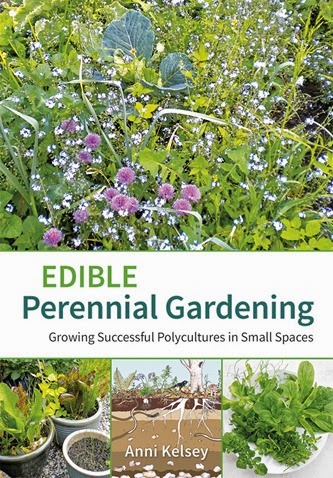 Foreword by Eric Toensmeier, author of Paradise Lot and Perennial Vegetables, co-author of Edible Forest Gardens.
Do you dream of a low maintenance perennial garden that is full to the brim of perennial vegetables that you don't have to keep replanting, but only have a small space? Do you want a garden that doesn't take much of your time and that needs little attention to control the pests and diseases that eat your crops? Do you want to grow unusual vegetable varieties? You can have all of this with Edible Perennial Gardening.
Anni Kelsey has meticulously researched the little known subject of edible perennials and selected her favourite, tasty varieties. She explains how to source and propagate different vegetables, which plants work well together in polycultures, and what you can plant in small, shady or semi-shady beds as well as in sunny areas. It includes:
-
Getting started and basic principles
-
Permaculture, forest gardening and natural farming
-
Growing in polycultures
-
How to chose suitable leafy greens, alliums, roots, tubers and herbs
-
Site selection and preparation
-
Building fertility
-
Low maintenance management strategies
If you long for a forest garden but simply don't have the space for tree crops, or want to grow a low maintenance edible polyculture, this book will explain everything you need to know to get started on a new gardening adventure that will provide you with beauty, food for your household and save you money.
Anni Kelsey graduated with a first class degree in geography from Aberystwyth University in 1990. She has worked as a research officer for a council's Economic Development Department and on various Urban Regeneration projects. She is passionate about permaculture, forest gardening and the Transition Movement.
There have been books on this subject, certainly, written by other authors but geared, predominately at US or Australian growing areas and conditions. Thanks to Anni Kelsey we now have a book on this matter written with the British and (Northern) European gardener in mind, finally.
Polyculture, for the uninitiated, is agriculture, or horticulture, in this case food gardening, using multiple crops in the same space, in imitation of the diversity of natural ecosystems, and avoiding large stands of single crops, or monoculture. It includes multi-cropping, intercropping, companion planting, beneficial weeds, and alley cropping. It is one of the principles of permaculture.
Polyculture, though it often requires more labor, has several advantages over monoculture namely that the diversity of crops avoids the susceptibility of monocultures to disease.
A study in China, for example, reported in “Nature” showed that planting several varieties of rice in the same field increased yields by 89%, largely because of a dramatic (94%) decrease in the incidence of disease, which made pesticides redundant.
The greater variety of crops also provides habitat for more species, increasing local biodiversity. This is one example of reconciliation ecology, or accommodating biodiversity within human landscapes. It is also a function of a biological pest control program.
Written from experience rather that simply from what has been researched by means of what others have written and done this book – by way of a personal story and account – tells of the pitfalls as much as of the successes of edible perennial gardening and polyculture, this is the book for anyone of us interested in trying this kind of food gardening and I, certainly, shall have a closer look at doing it. I am already growing “edible weeds”, such as dandelion, sorrel and others and all I now need are some “nice” perennial vegetables together with annuals, left as perennials, maybe.
A real great book from once again from Permanent Publications and another one that I am happy to endorse.
© 2014
 We recently published Looby Macnamara's second book, 7 Ways to Think Differently. This little book is like good medicine - it is potent - it goes a long way. I couldn't attend the book launch at the UK Permaculture Convergence because my better half, Tim, was recovering from an operation so I wrote a short speech about how thinking shapes our worldview and why it is particularly important at this time in human history. In true multi-functional fashion, I thought I'd share what I said and expand on it here.