Parents across the UK agree that technology is damaging their children

Parents across the UK agree that technology is damaging their children and would like to go back to the ‘old days’ and pledge their support for the UK’s National Unplugging Day.

By Michael Smith (Veshengro)

Parents across the UK agree that technology is taking over their lives and is damaging their children. Individuals are being urged to unplug on Sunday 26 June 2016 in celebration of the second annual National Unplugging Day in the UK.

National Unplugging Day is asking all individuals and families to put down their smartphones, tablets and computers for 24 hours to experience life unplugged.

Parenting experts warn that digital devices are harming relationships, stopping the young from developing face to face communication skills and teaching children that disappearing into digital devices for hours is a healthy activity.

A study with over 2000 parents from across the UK found that the average parent spends up to 5 hours per day on a smartphone. Typically their children are spending similar times using screens with 80% of children spending 4-5 hours per day on digital devices and with 15% of children spending in excess of 6 hours of screen time across various devices.

Nearly all the parents surveyed (87%) agreed that technology is damaging to their children’s childhood and nearly all the parents surveyed (94%) wanted the tech industry to help educate them and offer guidelines for safe usage. The statistics also show that more than half of parents (51%) would like to go back to the days of no technology or smartphones and a life less complicated.

The survey also discovered that 41% of parents agreed that family times are ruined from digital distractions and 42% of parents said they use technology to calm their children down or to stop family arguments.

The statistics also revealed that more than a third of parents (37%) agree that communication with their children is being harmed by today’s technology.

As smartphones and advances in technology invade our daily activities, parents are increasingly less present and available for their children and mental health officials are very worried on the long term effects this may have on our children.

With the evolution of the internet and smart phones, families can now often be found in the room together but not actually spending any real time bonding or sharing experiences. With modern families comprising of two full time working parents, it can be common to find both parents glued to their laptops or phones and despite wanting to spend more time with their children they are pulled in the direction of work via technology. Work does not end when you leave your office anymore.

It is even known that in a number of families the dinner gong – well, they may not actually have had one, but whatever – has been replaced by a tweet or a Facebook message or SMS to the children who are in the same house, just upstairs, or such, in their rooms.

It is high time that people unplugged again and engaged in life without a digital connection and be present for their children.

The National Day of Unplugging recognizes the value and importance of technology in today's society whilst trying to encourage people, especially families and young children and the connected generations who have grown up with ever-present technology, to be more mindful of their digital usage. This day is not intended to be a one-off, but rather a starting point to encourage people of all ages to embrace a healthy lifestyle by regularly setting aside time away from their digital devices.

© 2016

How to Make Rooting Hormone with Willow

You probably know that willow bark was the basis for the common over-the-counter drug, Aspirin™ or acetylsalicylic acid (ASA). Young willow twigs contain both salicylic acid, which serves as an antifungal, and indolebutyric acid, a hormone which encourages rooting. Commercial rooting hormone contains Indole-3-butyric acid, a concentrated synthetic version of this naturally occurring rooting hormone, as well as a chemical fungicide. But if you are avoiding chemicals in your organic garden, willow is a powerful substitute. Oh, and did I mention it’s free and easy make?

Rooting hormone made from willow is free and easy to make. Use it for rooting cuttings or for easing transplant stress.

Willow rooting hormone works in two ways. You can soak cuttings that you plan to root in willow water for 24 hours and then plant them in soil. Or you can water already rooted cuttings with prepared willow water to encourage stronger roots.

Advantages of willow rooting hormone

  • Willow is free.
  • Using willow rooting hormone speeds up the rooting process.
  • The antifungal properties of willow improve the success rate of your propagation projects.
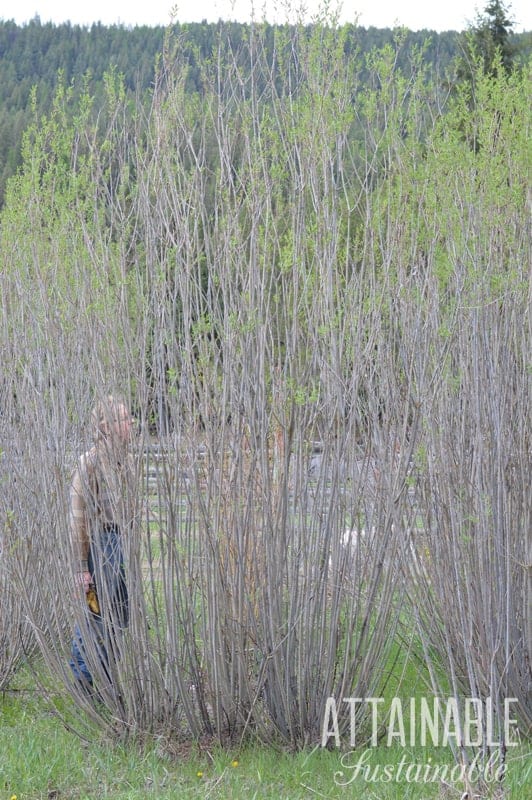
  • You can make as much rooting hormone as you need from one or two willow shrubs.
  • Cutting the willow to make rooting hormone actual stimulates new growth in the willows.
  • The willow that you have growing in your own yard has already produced defenses against the most common fungal and bacterial challenges in your environment. When you make rooting hormone from these willows, you are giving your new plants the defense they need against these pathogens, allowing them to put more energy into growth. This will improve your propagation success rate.
  • While commercial rooting hormones contain a single fungicide and a single hormone, organically grown willow will have several synergistic constituents that will help with your propagation success.

Read more here.

Ernten statt Jäten: Essbare Bodendecker zur Unkrautbekämpfung

Ernten statt Jäten: Essbare Bodendecker zur UnkrautbekämpfungWenn du einen Garten bewirtschaftest, kennst du das bestimmt. Gerade noch umgegraben und ausgesät und schon ist wieder alles grün, nur leider wachsen neben den gewünschten Pflanzen auch jede Menge ungeliebte Kräuter und Gräser. Üblicherweise bedeutet das, regelmäßig viel Zeit in die händische Entfernung ungebetener Gäste im Beet zu investieren oder mit anderen Mitteln dafür zu sorgen, dass die Bepflanzung nicht überwuchert oder sogar ganz verdrängt wird. Warum also nicht einfach das Problem in einen Vorteil umwandeln? Mit einem einfachen Trick kannst du mit weniger Aufwand mehr ernten und deinen Speiseplan um gesunde und schmackhafte Vitalstofflieferanten bereichern. Alles, was du dazu brauchst, sind so genannte Bodendecker, die auf Pflanzen, Licht- und Bodenverhältnisse in deinem Garten abgestimmt sind.

Eigenschaften von Bodendeckern

Der Sammelbegriff Bodendecker umfasst Pflanzenarten, die sich durch ein niedriges, primär horizontales Wachstum auszeichnen. Im Hinblick auf die Unkrautbekämpfung bieten sie den Vorteil, dass sie eine offene Fläche in sehr kurzer Zeit bedecken können. Der auf diese Weise entstehende Teppich aus Blättern, Blüten und Früchten bewirkt einen verminderten Lichteinfall auf den darunter liegenden Boden, wodurch das Wachstum unerwünschter Wildpflanzen zurückgedrängt wird. Gleichzeitig schützt er die Erde vor Austrocknung, schafft Lebensraum für Nützlinge und sorgt mit seinem weit verzweigten Wurzelwerk für einen natürlichen Erosionsschutz. Einer der bekanntesten Bodendecker ist Efeu, aus dessen Blättern du ein effizientes und gleichsam umweltfreundliches Wasch- und Spülmittel herstellen kannst.

Essbare Bodendecker

Bodendecker haben aber noch viel mehr zu bieten. Unter ihnen befinden sich viele Sorten mit essbaren Früchten oder Blättern. Einige gedeihen sogar in Schattenbereichen unter Bäumen, wo sich andere Pflanzen schwertun. Andere eignen sich als pflegeleichte Zwischenkultur für bereits abgeerntete Beetbereiche oder als essbarer Bodenschutz unter Tomaten- und Bohnenstauden. Dort ausgesät oder gepflanzt breiten sie sich aus und hemmen das Wachstum unerwünschter Unkräuter und Gräser, sodass das lästige Unkrautjäten mehr und mehr entfällt. Aufgrund der großen Anzahl bodenbedeckender Pflanzen gibt es eigentlich für jede Stelle im Garten die passende Sorte.

Hier weiterlesen.

Ethanol saves oil and reduces pollution

by Michael Smith (Veshengro)

Ethanol saves oil and reduces pollution, or so we are being told. But the truth is a completely different one and no one wants to talk about that.

Ethanol, one of the so-called biofuels, the other is biodiesel, is produced, primarily, especially in the USA, from corn (maize), with biodiesel, mainly, being made from palm oil. The latter shall, however, not stand for discussion here at the moment.

So, they tell us that ethanol saves oil and reduces pollution but no one speaks about the oil-based products and the diesel required to put the corn into the ground, to spray it with pesticides, to harvest it and to process it. The fact is that the public is being sold a lie.

For every bushel of corn produced to ethanol half a gallon of oil is needed (for the metrically minded person a bushel is just a little of quarter of a metric ton and half a gallon US equals about two liters) in the form of pesticides, chemical fertilizers, fuel for the drilling of the crop, etc. And then more fuel, in the form of energy, is required for the processing of the maize into ethanol, followed by yet more fuel to get the ethanol to the filling stations. That about covers the fuel, predominately in the form of oil, being used.

Now we come to reduction of the pollution, which does not exist, for the plants which process the corn into ethanol create pollution, the fertilizers and the pesticides do, and so on.

When everything, I should reckon, is calculated then the problem is rather the opposite to an improvement and it could almost be a case of higher use of fuel to create a fuel.

The only reason that the companies making ethanol make ethanol is because of the government subsidies that that attached to it. Otherwise it simply would not be profitable and they would not make it. And the same is the case as regards to biodiesel which has been shown to have far more dangerous emissions, especially of nanoparticles, than ordinary oil-based diesel and those nanoparticles are reckoned to be the causal agent for the increase of asthma, especially in children.

So, are we jumping from the proverbial frying pan into the fire? It very much would appear to be the case.

In addition to that bio-diesel and bio-ethanol both use valuable land. In the former case it is a variety of crops, often palm oil palm, that are grown in tropical rainforest areas and lead to the destruction of said forests while in the latter case it is corn or other crops that are grown on fields that would be much better used for the growing of food for human consumption.

Time for a serious rethink, methinks...

© 2016

Risk is essential to childhood – as are scrapes, grazes, falls and panic

Children need to be exposed to risky play. For ‘helicopter parents’, this might be difficult - but kids need to learn to manage danger themselves

Following the all-party parliamentary group report on a fit and healthy childhood, diligent parents everywhere are wondering how much risk they should introduce into their children’s lives. The report stated that: “Risky play, involving perhaps rough and tumble, height, speed, playing near potentially dangerous elements such as water, cliffs and exploring alone with the possibility of getting lost, gives children a feeling of thrill and excitement

Risk is an essential component of a balanced childhood. Exposure to healthy risk, particularly physical, enables children to experience fear, and learn the strengths and limitations of their own body. However, before you book a one-way ticket to Beachy Head for you and the toddler, or dump the iPad-loving six-year-old in the woods with just a compass, let’s think about this more carefully.

For this generation of children, shuttled from padded soft play, to school, to club, to sofa, we’ve got a lot of work to do before they come over all Bear Grylls. As parents, many of us are unaccustomed to allowing even the tiniest degree of danger to enter the lives of our children. Surely it’s the job of a good parent to keep them safe? That’s why roaming distance (how far children play from home) has decreased by 90% in the past 30 years.

Read more here.

Q&A With Cycle Farm

Bicycles and growing cycles—everything’s a-spinning to keep this small-scale farm in business.

Why reinvent the wheel? While that might seem unnecessary, farmers like Trish Jenkins and Jeremy Smith often have innovative minds, dreaming up ways to do things more efficiently and, well, simply better. Their Cycle Farm, in the northern Black Hills of South Dakota, is a small, diversified mixed vegetable farm. With over 40 different crops and an active CSA, the duo is committed to building community through the use of human-powered and regenerative farming practices. We spoke with Trish Jenkins about the creative ways they use bicycles on their farm to keep things in motion.

1. Why did you name your farm Cycle Farm?

Trish Jenkins: We’re excited about bicycles as transportation and smart, efficient tools for small scale farms— they’re also irresistibly fun, engaging and offer a great way to interact with your community, neighborhood or city. The name Cycle Farm encapsulates our love for bicycles, as well as honors all the profoundly important natural cycles that we work with as farmers—everything from days and seasons, life and death, to soil nutrient cycling and the hydrologic cycle. We’re committed to producing food in a way that fosters soil health and promotes a diverse local ecology, and part of this is minimizing our inputs and fossil fuel use by using bicycles and human power.

Read more here.

Aldi LED 5W Trekking Torch – Product Review

Review by Michael Smith (Veshengro)

Aldi LED Trekking Torch 5W
Product Ref: 093239024654200
£ 6.99

LED-Trekking-Torch-5W-AThe brand of this torch is Cree LEDs and it is available in all black or a black and green combination. The material of the body is aluminium and galvanized steel. Run time estimated to be 3.5 - 7 hours depending on whether full power or low power operation used.

As per almost usual with battery-powered products at Aldi batteries are included. Also included is a nylon web belt pouch with a “Velcro” closure. As the torch does come with a pen-style clip the pouch is, to some extent, rather superfluous.

The torch has a claimed beam length of 130m, which is difficult to check, obviously, unless one can actually measure it, but let me put it this way that this is so far the small LED torch, what our American cousins refer to as a flashlight, with the farthest reach.

It has a 3 mode operation, 100%, 50% and off, is said to be waterproof as well as impact and shock resistant. I am glad that it does not have a flash mode, as do so many, as I do find that one rather a useless one.

The light can be switched between beam and flood by pulling the outer part of the head of the torch forward or back. Back is flood and forward full beam.

What I especially like about this torch is that, unlike so many LED ones nowadays, it does not employ a carrier for 3 AAA batteries but uses 2 AA ones behind each other and thus avoiding the problem often encountered with the carriers where one battery may not connect properly and thus the light output drops.

This torch, I would reckon, is equally useful for outdoors activities and trekking as well as for use by security personnel.

This torch is part of the Aldi special buys and thus means it is only available as and when and thus it is advisable to stuck up when they are there. Having tested it I wish I would have gotten another one as a spare.

Rating: From what I have seen so far the Aldi LED Trekking Torch 5W will have to get 5 out of 5.

© 2016

Disclosure statement: Unlike generally when reviewing a product this one was actually purchased and reviewed because it was liked. It was not provided by Aldi nor their suppliers nor the manufacturer of the product.

Build Better Garden Soil With Free Organic Fertilizers!

Avoid high fertilizer costs — here are your best organic fertilizers, including two that you won’t even have to pay for! Build better garden soil using organic fertilizers found in your very own backyard.

Fertilizer

As more and more people recognize the many benefits of organic gardening methods, a fresh crop of organic fertilizers are sprouting on store shelves. Many are overpriced, and some are stunning rip-offs that reputable stores and catalogs should be ashamed to sell. The really amazing thing is that two of the best organic fertilizers are easily available to most of us absolutely free! (See below) It’s definitely a buyer-beware world out there. If you’re not careful, you could pay five, 10 or 4,000 times more than necessary to get the nitrogen and other nutrients you need. Here's what we found when we evaluated the pricing for 21 fertilizers:

The Best Free Fertilizers

All products labeled as “fertilizer” must be labeled with their content of the three major plant nutrients — nitrogen, phosphorous and potassium (N-P-K). Most organic fertilizers are bulkier than synthetic chemical products, so their N-P-K percentages are typically lower than synthetic products, and their application rates are higher.

Also, because organic products are biologically active, their N-P-K numbers may change somewhat from batch to batch and over time. Because of this, it can be hard for producers to comply with the labeling laws. As a result, some excellent organic fertilizer options, such as compost, often are not even labeled as a “fertilizer.” One of the best free fertilizers, grass clippings, break down so quickly that they can’t be bagged and sold.

But make no mistake, compost and grass clippings do what fertilizers are supposed to do: They enrich the garden soil with nutrients that plants and microscopic soil life-forms are eager to use. In most areas, you can easily collect grass clippings from your neighborhood, bagged and set out ready to bring home. And many communities make yardwaste compost (made mainly from grass clippings and leaves) available for free.

So, if you can get free clippings or compost, how much should you use? Here are guidelines prepared with help from soil scientists at Woods End Laboratory in Maine.

Grass Clippings: Just Half an Inch Will Do!

Grass clippings are one of the best organic fertilizers. Not only because it’s easy to find free local sources, but also because the clippings do double duty preventing weeds and conserving garden soil moisture when used as mulch — two things other fertilizers cannot do. Nitrogen content of clippings will vary, with fresh grass collected in spring from fertilized lawns topping 5 percent nitrogen, while clippings from later in the year or from unfertilized lawns will likely contain around 2 percent nitrogen. (Be sure to avoid clippings from those “perfect” lawns that have been treated with herbicides.)

Read more here.

Weed-Control Goats

Goats are a natural way to keep weeds under control without the use of herbicides or heavy equipment.

Goats are useful animals, providing us with milk, meat and wool. They have fulfilled these important roles for thousands of years, enabling humankind to survive and thrive on just about every continent. In today’s world, where most people buy their meat and dairy in the grocery store and wear clothing made from synthetic materials, some goats have found new ways to help humans get through the day. These special goats — represented by many goat breeds — serve as goats in 4-H, pack goats for hikers and companion goats.

Another goat activity that is gaining interest throughout the United States is vegetation control. Weedsare tasty to most goats, which are natural browsers. This makes the use of goats an excellent method to control unwanted vegetation without the use of herbicides or heavy equipment.

This method of using goats to keep weeds to a minimum, called “mitigation,” helps reduce the risk of brush fires. In the Western United States, the use of goats for weed control is becoming popular. Some goat owners have started their own small businesses, hiring their goats out to land owners and even government municipalities for vegetation control.

Read more here.

Microplastics in the sea a growing threat to human health, United Nations warns

More than a quarter of fish in markets in Indonesia and California contain plastic particles

Plastic-waste_1.jpg

Millions of tons of tiny debris from plastic bags, bottles and clothes in the world’s oceans present a serious threat to human health and marine ecosystems.

This is the stark warning issued by the United Nations in a report on the most dangerous environmental problems facing the world today.

Global plastic production has increased dramatically in recent years. Between 2004 and 2014, the amount of plastic produced rose by 38 per cent, the report said.

And poor waste disposal means when we have finished with our takeaway containers, cigarette butts and party balloons, they are worn down into trillions of ever-smaller particles by the waves.

There is a growing presence of these microplastics, particles of under 5mm in length, in the world’s oceans.

In 2010, between 4.8 million and 12.7 million tons of plastic was washed into the seas and has since shown up in the stomachs of whales, plankton and other marine life.

Read more here.